Lesson #99 The Fundamental Theorem of Calculus
and Properties of the Definite Integral
|
Quote of the Day:
"It is clear that Economics, if it is to be a science at
   all, must be a mathematical science ... simply because
   it deals with quantities...
   As the complete theory of almost every other science
   involves the use of calculus, so we cannot have a true
   theory of Economics without its aid."
      -- W. S. Jevons

Objectives:
The student will learn the properties of the definite
   integral and apply them when solving integrals.

The student will learn the Fundamental Theorem of Calculus and apply it.

1. Collect Homework.

2. The Fundamental Theorem of Calculus
      Each branch of mathematics has a fundamental theorem
      associated with it.

      The Fundamental Theorem of Arithmetic:
        Any positive integer can be represented in exactly
        one way as a product of primes.

      The Fundamental Theorem of Algebra:
        Every polynomial of degree n has exactly n zeroes.

      The Fundamental Theorem of Geometry:
        No theorem wears this title, but perhaps the
        Pythagorean Theorem deserves it.

      The Fundamental Theorem of Calculus – there are
        actually two parts to this theorem:

        The First Fundamental Theorem of Calculus:
          The derivative of the integral of a function
            is equal to the function.

        The Second Fundamental Theorem of Calculus:
          The integral of the derivative of a function is
            is equal to the function evaluated at its
            endpoints.

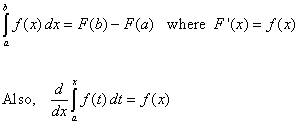
   The F.T.C. tells us that we can evaluate a definite
      integral by taking an indefinite integral and
      substituting in the endpoints and taking the
      difference:
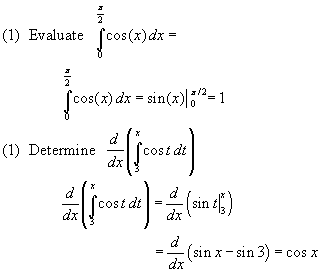
3. Example:
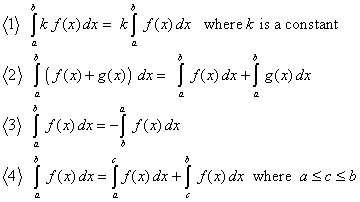
4. Properties of the Definite Integral
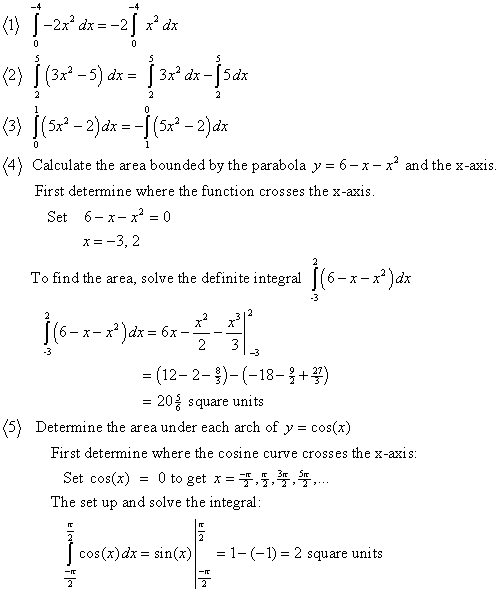
5. Examples of the Properties of the Definite Integral
6. Compute the Definite Integral in this Comic Strip
7. Assignment p. 415 (22, 24, 25) p.425 (3, 6, 10, 12, 13) |