|
Quote of the Day:
     "Mathematics -- the subtle fine art."  -- Jamie Byrnie Shaw"

Objectives:
    The student will apply the delta-epsilon definition of a limit
to making a Hexaflexagon.

1. Collect Homework.

2. Distribute sheets of adding machine paper to each student -- they
	should be three feet in length.
   Begin folding the sheets to form triangles – eventually they will
   	become equilateral triangles.  Take the sheet and fold down
	and make a crease.  Then unfold the paper and fold up along
	the crease, making another crease.  Then unfold and fold down
	along the last crease.  Continue this process until you have
	25 triangles.
   The last 19 triangles are the ones we will use – they should be
	very close to equilateral!

3. The purpose of this exercise is to see that the angles in the
	triangle are approaching 60 degrees.  Here is a proof (making
	the triangles equilateral):
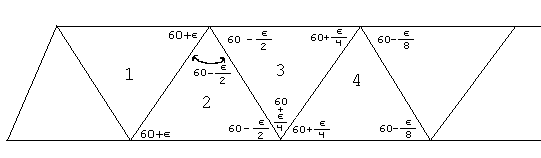
   Represent the first angle in triangle #1 by 60 + e degrees, where
	e is the difference between the measure of the angle and 60
	degrees.  Then using alternate interior angles, there is an
	angle in triangle #2 which has this same measure.  Since the
	sum of the angles along a line equal 180 degrees, and the
	transversals represent the folds, the middle angle at the top
	of triangle #2 must equal 60 – e/2 degrees.  Then continue
	using alternate interior angles and the sum of the angles
	along a line equaling 180 degrees to discover the measures of
	the remaining angles.  Notice that the angles are approaching
	60 degrees:
	from (60+e) to (60-e/2) to (60+e/4) to (60-e/8) to (60+e/16), etc.
	If the original angle was 80 degrees, so that it was  off by
	20 degrees (e = 20), then by triangle #5, e = 20/16 = 1.5
	degrees!!!!  So the angle would equal 61.5 degrees.  And the
	next ones would be closer.
Click here for instructions on folding and flexing the Hexaflexagon
5. Assignment:
             Finish decorating all 6 sides of the Hexaflexagon
             p. 137 (6, 12, 30, 31)
             p. 145 (6, 16, 17)
Click here to go to the next page
|