Lesson #20
Rates of change
|
Quote of the Day:
   "All the mathematical sciences are founded on the
    relations between physical laws and laws of numbers."
      -- James Clerk Maxwell

Objectives:
    The student will determine the Average Rate of Change
    	of a function over a given interval.
    The student will determine the Instantaneous Rate of
	Change of a function at a given point.

1. Collect Homework.

2. Average Rate of Change vs. Instantaneous Rate of Change
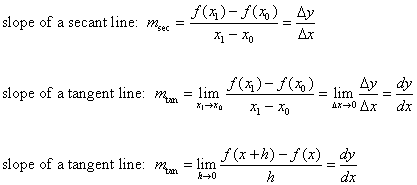
   Slope of a secant line vs. Slope of a tangent line
   Average velocity vs. Instantaneous velocity

     Slope is a rate of change of y with respect to x.

     Average rate of change takes place over an interval
	while instantaneous rate of change takes place at an
	instant.

     Average velocity occurs over a specific time interval
	while instantaneous velocity is what is shown on your
	speedometer.
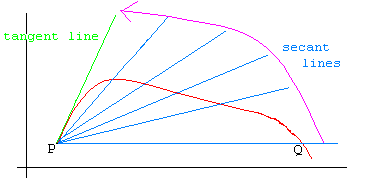
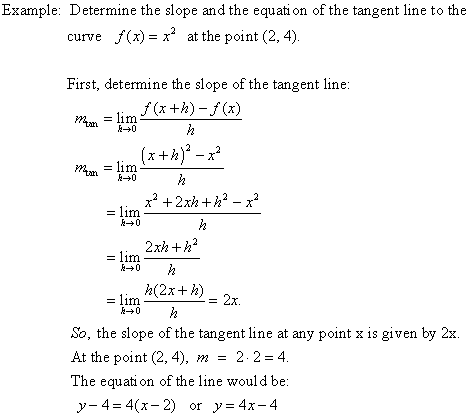
If a secant line is drawn between two points, P and Q, on a curve y = f(x), and if Q is allowed to move along the curve toward P, then the secant line will rotate toward a limiting position (which is the tangent line at P). 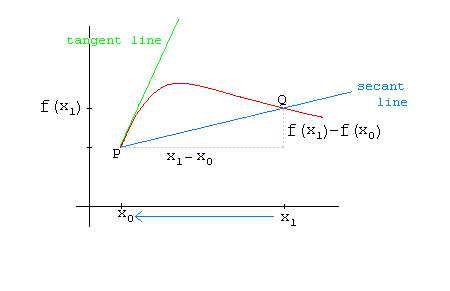
3. Examples:

   In Mount Rainier National Park, here are some of the
   hiking trails in the Longmire area:

   (1)	Trail of the Shadows:
        .7 miles round-trip;
        average hiking time is 30 minutes.

   (2)  Carter Falls/Madcap Falls:
        2.2 miles round-trip; 500' elevation gain;
        average hiking time: 2 hours.

   (3)  Rampart Ridge:
        4.6 mile loop; 1,339' elevation gain;
        average hiking time: 2.5 hours.

   (4)  Comet Falls and Van Trump Park:
        5.6 miles round-trip; 2,200' elevation gain;
        average hiking time: 4 hours.

   (5)  Wonderland Trail to Indian Henry's:
        6.7 miles one way ; 2,400' elevation gain;
        average hiking time: 4 hours.

   (6)  Wonderland Trail to Paradise:
        6 miles one way; 2,700' elevation gain;
        average hiking time: 3 hours.

   (7)  Eagle Peak Saddle:
        7.2 miles round trip; 2,955' elevation gain;
        average hiking time: 5 hours.

   Determine the AVERAGE RATE OF CHANGE OF THE DISTANCE WITH RESPECT
   TO TIME of some of the trails.

   Determine the AVERAGE RATE OF CHANGE OF THE ELEVATION WITH RESPECT
   TO THE HORIZONTAL DISTANCE (you must solve for this
   horizontal distance since the information given is the
   elevation and the distance traveled).

4. Assignment:
      Read pages 169 - 175
      p. 175 (2, 9, 17, 18)
|