|
Quote of the Day:
"The shortest distance between two points is under construction."
           -- Bill Sanderson

Objectives:
   The student will compute higher order derivatives.
   The student will be able to compute velocity and
acceleration for a given displacement function.

1. Collect Homework.

2. Higher-Order Derivatives (Second derivatives, …)
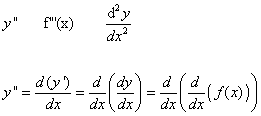
     To determine the second derivative, take the
	derivative of the first derivative.

     The notation for the second derivative:
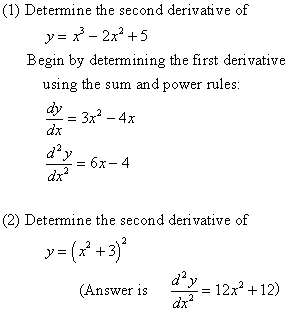
Examples:
3. Distance, Velocity, and Acceleration

  A. Problem:
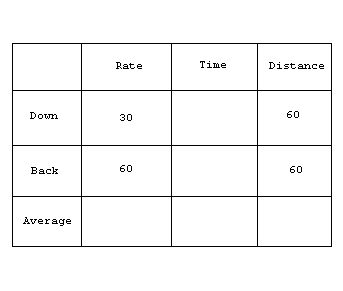
	You make a roundtrip from Winchester to Harrisonburg,
	a distance of 60 miles one way (actually, any distance
        will work in this problem).  If you travel down at
        30 m.p.h., and return at 60 m.p.h., what was your
        average m.p.h. over the whole trip?

	Use the following table to help answer the problem:
  B. Problem:
	There is a single path up a mountain in Shenandoah
	National Park.
	A mountaineer starts up at 7:00 AM and arrives at the
	top at 7:00 PM. She stays there overnight.
	The next morning, she starts back down at 7:00 AM and
	arrives at the bottom at 7:00 PM.
	On both days, she travels at varying speeds – enjoying
	the scenery, stopping for lunch, smelling the roses…
	What is the probability that there was a spot on the
	trail that she passed at exactly the same time on both
	days?


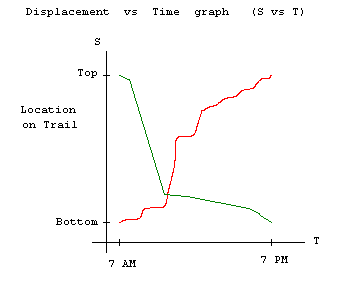
	Hint: Draw a Displacement – Time graph!

	Answer: It is 100%.  Look at the Displacement-Time
	Graph – it doesn't matter how long she takes to come
	back down, there must be at least one place where the
	descent curve must cross the ascent curve.
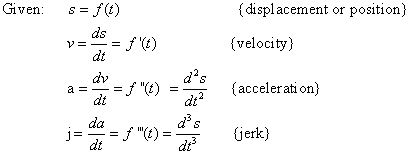
  C. Given a displacement curve,  s = f(t)
        The velocity is defined to be the change in the
	displacement divided by the change in time,
	or in other words, the first derivative of
	displacement with respect to time.
	It measures how fast you are going.

	The acceleration is defined to be the change in the
	velocity divided by the change in time, or in
	other words, the derivative of velocity with
	respect to time.
	When you press down on the accelerator in your
	car, you are changing the velocity.

	The jerk is a sudden change in acceleration.  When
	a ride in a car is jerky, it is not that the
	accelerations involved are necessarily large but
	that the changes in acceleration are abrupt.
	Jerk is what spills your soft drink.
	The derivative responsible for jerk is the third
	derivative of position.
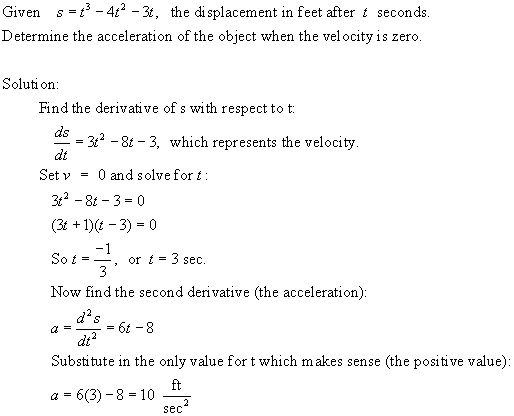
Example:
4. Assignment:
      p. 197 (3, 29, 30, 33, 41, 44, 45, 47, 67)
Click here to go to the next page
|