In this trick, you are given 16 numbers arranged in a 4 x 4 square:
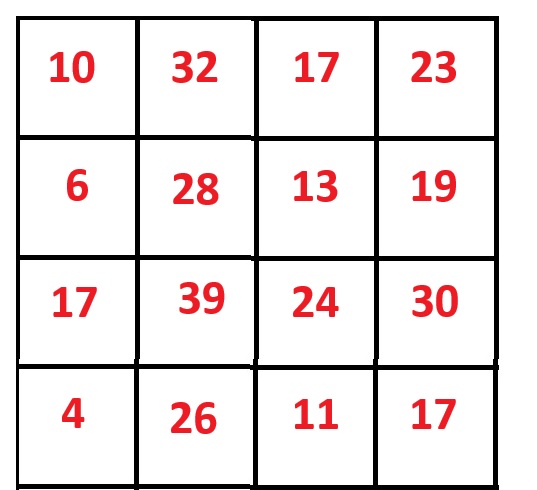
You are asked to pick four numbers, and after each number is picked, you remove the remaining numbers in each row and column.
Then you add the numbers together to get the sum.
No matter which numbers are picked, you always wind up with the same sum of 79.
How were these sixteen numbers obtained?
It turns out that the sixteen numbers are the sums of eight numbers in an addition table.
First, we need to find 8 different numbers which add up to 79.
I came up with 1, 3, 5, 8, 9, 14, 16, and 23.
I arranged those eight numbers at random in the four positions on the top row and the four positions in the first column of the
addition table in figure one below.
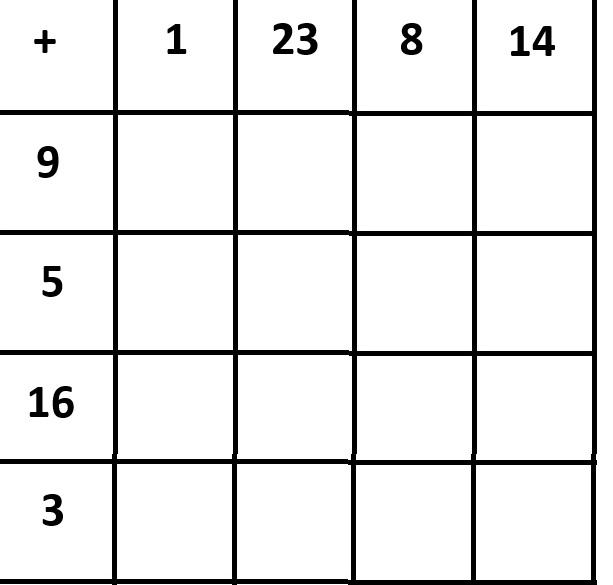
Now, we construct the addition table. Going along the first row inside the table, 9+1 = 10, 9+23 =32, 9+8 = 17, and 9+14= 23.
So, inside the table, row one reads, 10, 32, 17, 23.
For row 2, add 5 to each of the four top numbers to obtain 6, 28, 13, 19.
Now, do the same for rows 3 and 4, adding 16 to each of the top numbers, and then adding 3 to each of the top four numbers.
You now have a completed addition table (see figure 2 below).
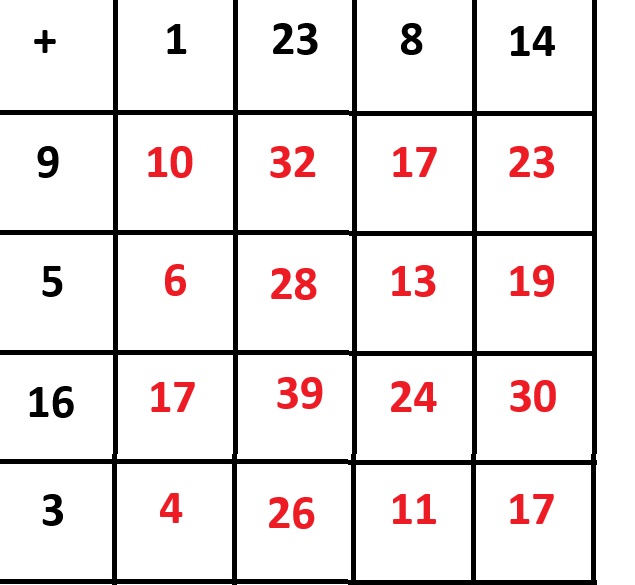
Now you remove the top and left-hand numbers which created the addition table.
See figure 1 above. You present your student with just this part of the table and ask them to select four numbers but remove the other numbers in the rows and columns
after selecting each number.
Try this with several different selections to make sure it works.
Let's do an example:
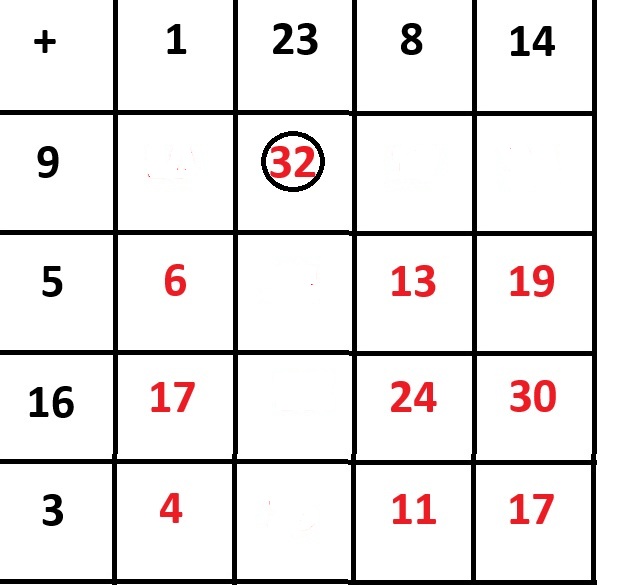
Let's say that you pick the number 32 in row 1, column 2.
Remove the other numbers in row 1 and in column 2.
See figure 4 below.
Now you select the number 4 in row 4, column 1. Then remove the other numbers in row 4 and in column 1.
See figure 5 below.
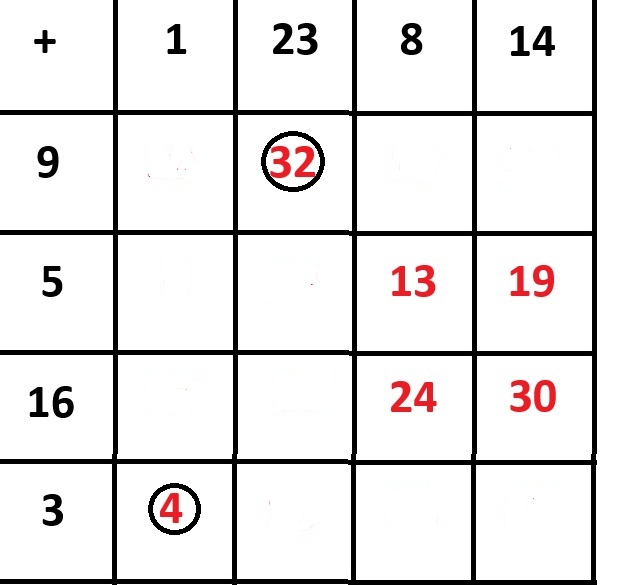
Now select the number 13 in row 2, column 3.
When you remove the other numbers in row 2 and in column 3, you are left with just the number 30 in row 3, column 4.
See figure 6 below.
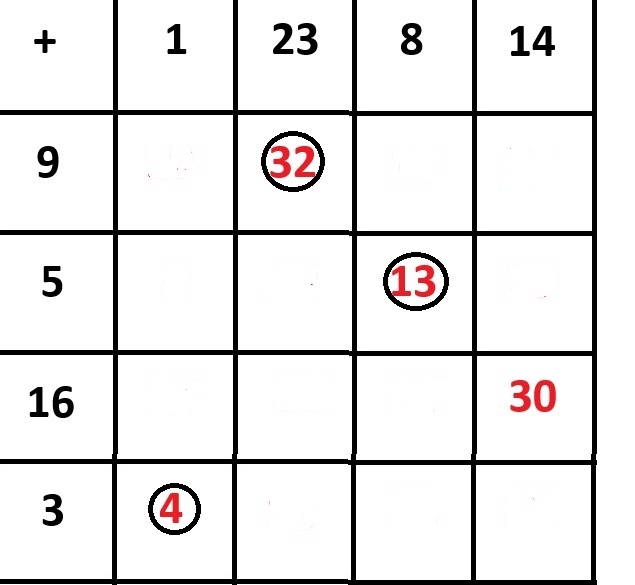
And the four numbers we selected add up to 79: 32 + 4 + 13 + 30 = 79.
So the trick works.
Why does it work?
Look at figure 7.
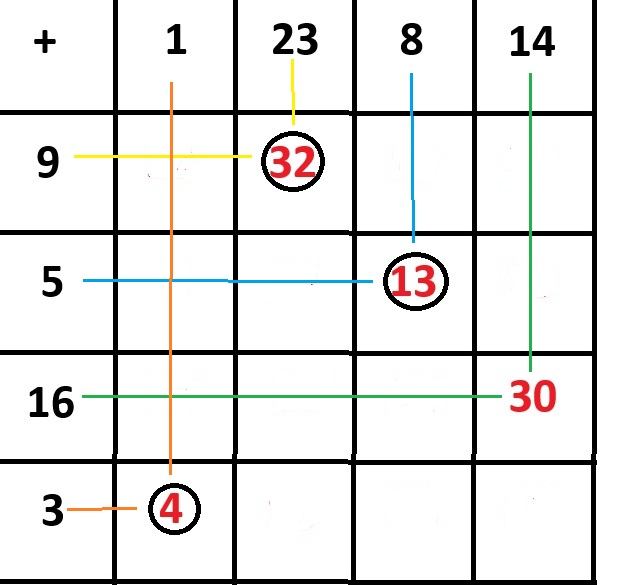
Each of the four numbers we selected was the sum of 2 of the original 8 numbers that made up the addition table.
And because we restricted the choice of the numbers so that no two numbers could be picked in the same row or column,
we assured ourselves that the four numbers picked would add up to 79.
Penn & Teller used this idea of an addition table in one of their tricks:
Click here to see the trick
Click here for an explanation of Penn & Teller's trick